Ask a plant how much it spends on raw material and you'll get a number to the dollar. Ask how much it spends on bearings, belts, filters, cutting tools, gloves and fittings, and you'll usually get a shrug.
That second category is MRO: maintenance, repair and operating supplies. It's rarely the biggest line in the budget. But it's the one with the least control, the most transactions, and the most direct link to unplanned downtime.
Why MRO falls through the cracks
Production materials have a whole system behind them. They're on the bill of materials, the ERP plans them, purchasing negotiates them, receiving checks them in. MRO has none of that.
- It's thousands of small items. Each one is too small to justify attention, so collectively they get none.
- Demand is irregular. A specific motor or gearbox might be needed once in three years, and then urgently.
- Many people can buy. Mechanics, supervisors and engineers all have a reason to order, often directly from a supplier's website or a counter.
- The item master is a mess. The same bearing exists three times under three descriptions, so nobody can see total usage or what's already on the shelf.
- Nobody owns it. Maintenance thinks purchasing manages it. Purchasing thinks maintenance knows what it needs.
What it costs
The visible cost is price: rush orders, no volume pricing, the same item bought from four suppliers at four prices. That's real, but it's not the big one.
The bigger cost is downtime. When a machine stops and the part isn't on the shelf, or is on the shelf but nobody can find it, the plant pays for idle labor, missed shipments and expedited freight. I've seen a single critical part with one source and a long lead time take a machine out for weeks. The part cost a few hundred dollars. The outage cost many times that.
The third cost is the opposite problem: shelves full of parts for machines the plant no longer runs, and duplicate stock of things nobody realized were already there. That's cash sitting idle.
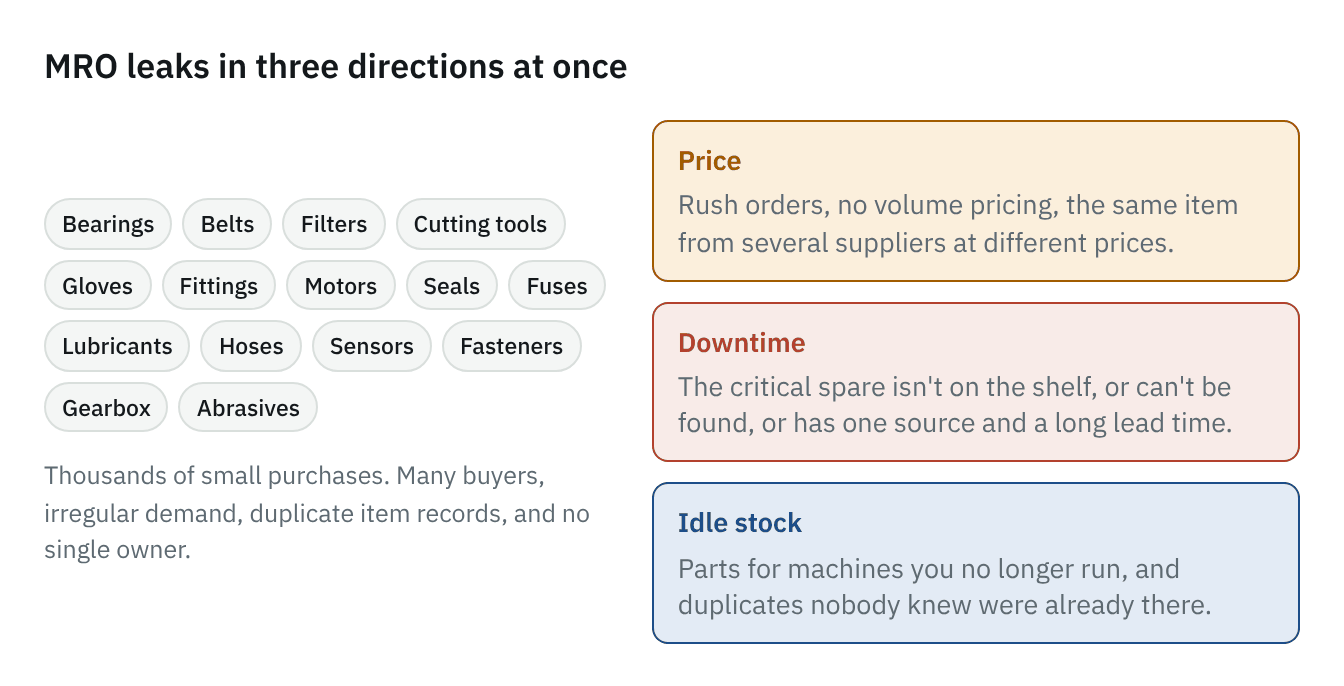
The diagram below puts the three together. On the left is what MRO actually is: thousands of small, unrelated purchases with no single owner. On the right are the three ways money leaks out of it. Most plants only ever look at the first one, price, which is why the bigger two persist.
Five controls that fix most of it
You don't need an enterprise procurement suite to get MRO under control. In my experience, five basic controls do most of the work.
1. One request path. Every MRO purchase starts as a request in one place, with the item, quantity, machine or reason, and urgency. It can be simple, but it has to be the only way to get something bought. This alone gives you visibility you didn't have.
2. A clean list of what you stock. Deduplicate the item master for spares and supplies. One description, one part number, a location on the shelf. It's tedious work, and nothing else works without it.
3. Know your critical spares. For each important machine, list the parts whose failure would stop it, then check three things: is one on the shelf, how long would a replacement take, and is there more than one source. The items that fail all three are your real risk list.
4. Stock by rule, not by habit. Decide which items to keep on the shelf and which to order when needed, based on how often they're used and how bad it is to be without them. A simple classification goes a long way; I'll cover one in the next piece.
5. Close the loop with maintenance. Parts usage should be tied to the machine and the work order. That turns purchasing data into maintenance insight: which machines consume the most parts, which failures repeat.
Why the requester's experience matters
Most attempts to control MRO fail for the same reason shop-floor systems fail: the people who need to use them don't. If the request form takes ten minutes, or approvals take two days, mechanics will go around it, and you're back to no visibility.
A good MRO request process is fast for the person asking: a couple of fields, a search that finds the right item, and an answer the same day. Control comes from everyone using one path, not from making that path difficult.
Where to start
Pull last year's MRO spend by supplier and by item description. Look for the same item bought from several suppliers, rush freight charges, and purchases made outside your normal process. Then sit down with your maintenance lead and list the ten parts that would hurt most if they weren't available tomorrow. Those two exercises usually take a day, and they tell you exactly where the money and the risk are.